To George Gabriel Stokes Tuesday 641
Royal Institution of Great Britain | Tuesday 642
Dear Stokes.
I send you the concluding paragraph of my paper:3 what I mean is this—suppose
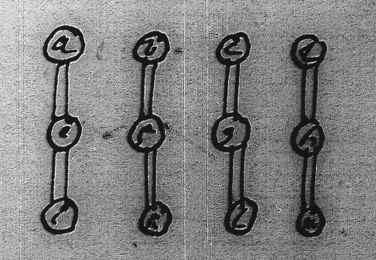
a b c d to be a series of atoms kept asunder by forces which we may visualise as longitudinally elastic rods which unite them suppose a vibratory motion imparted to a b c d: it will transmit itself thro’ the rods to e f g h., and from these again to the next series & so on.
Now suppose these atoms plunged in a medium capable of accepting their vibrations & transmitting them in all directions. I reason that the existence of this medium must interfere with the direct transfer of motion from atom to atom, and that if anything in the physical character of one atom causes it to communicate motion more readily than another atom to the medium, then the direct transmission of motion it will be more impeded in an assemblage of atoms of the former kind than of the latter.
Yours very truly | John Tyndall
I shall [sadly] want a copy of my paper in Switzerland.
CUL SC—add 7656
[5 July 1864]: the date is given by relation to letter 2117 (dated 30 June 1864), in which Stokes asked Tyndall questions that he responds to in this letter regarding his argument in his fifth memoir (see letter 2097, n. 3). The following Tuesday was 5 July 1864. See also letters 2097, 2112, 2114, 2115, and 2136.
64: the year is handwritten onto the letter, probably by LT.
my paper: see letter 2097, n. 3.
Please cite as “Tyndall2119,” in Ɛpsilon: The John Tyndall Collection accessed on