From James Fullagar to Ferdinand von Mueller 31 July 1874
Little River1
July 31st 74
My Dear Baron,
I think it may be safely stated that there is a difference between the length of of2 the spikes of Kentia Forsteriana and Kentia Belmoriana.3 Mr Moore says the spadix of K. Belmoriana is nearly twice as long as that of K. Forsteriana'.4 — K. Belmoriana has the longest spikes, and you are right in conjecturing those spikes, 3 to 5 feet long which I brought to belong to that species The spikes of Kentia Belmoriana spring singly from the axils of each leaf. The spikes you allude to were gathered from a young tree between 5 and 6 feet high in the stem. (Possibly in the older trees the spikes may not be quite so long.)
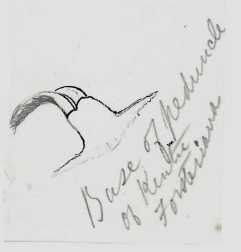
As to the Kentia Forsteriana or the "Thatch Palm" it differs from K. Belmoriana, in having a footstalk 1¼ inches or 1⅜ in. long by an inch in breadth from which in a specimen before me spring two (2) spikes. I think there are often more than 2 spikes springing from this peduncle, sometimes 3 or 4 — and this peduncle has a base about 3 inches in length partially encircling the circumference of the stem of the tree5 If I remember aright there were several small packages of the seeds of the Belmoriana and Forsteriana left at your office each separately labelled but I suppose in the inconvenience attending your removal from your former office, they got lost or confused6 The length of spike together with the petiole, not quite two and a half (2½) feet As I have observed previously the spikes of K. Belmoriana spring from the axils of the leaves, but the peduncles of K. Forsteriana, spring from the stem a short distance below the leaves.
The fruits of Belmoriana and Forsteriana, being of about the same size and color when dried, tho' Belmoriana has slightly the smallest and of slightly different shape are very apt to be confused, but I took great care to keep them separate. The seeds (fruits) of Forsteriana when ripe [are]7 of a bright red; of Belmoriana of a yellowish green, but often of a dirty nondescript colour a kind of dirty brown and many of the spikes had them almost black.
As to the height of the 4 palms. They attained frequently to the height of 25 feet 30 and I daresay 40 or even higher in the length of their stem; this is for the height of Forsteriana which grew as high as any of the species I think it is the highest of the palms and the one growing near the sea forming a belt along the coast. 40 feet is I should say a moderate estimate, all the high trees in the rich low land having been cut down for building purposes at least all the straight ones.
Forsteriana had a more slender stem and kept inland. Both Forsteriana and Belmoriana ascended with the Pandanus to a considerable height on the mountains where they were replaced by K. Canterburyana.
I think that the height of 25 and 30 feet will do for Belmoriana & Canterburyana. the mountain species, almost limited to the very summit (I allude to K Mooriana) was a dwarf palm, one could in almost every case pluck the ripe fruits with ease.
I[f]8 you wish it I could send the spike of K. Forsteriana with fruit of Belmoriana, fruit of Canterburyana & K. Mooriana9 or rather Moorei or any further particulars
Your truly
James P. Fullagar
Kentia Belmoriana
Kentia Canterburyana
Kentia Forsteriana
Kentia Moorei
Kentia Mooriana
Vic.
Word repeated in going from one line to the next.
K. belmoreana?
Mr Moore … K. Forsteriana is a marginal addition, its intended position indicated by an asterisk.
MS accompanied by a pencil sketch identified as: 'Base of peduncle of Kentia Forsteriana': 74-07-31_image01.jpg
I think there … lost or confused is an addition that begins at the bottom of the page and extends over the next page, its intended position indicated by an asterisk.
editorial addition.
editorial addition.
K. mooreana?
MS removed to the library from the collections at MEL at an unknown date, without the provenance being recorded.
Please cite as “FVM-74-07-31,” in Correspondence of Ferdinand von Mueller, edited by R.W. Home, Thomas A. Darragh, A.M. Lucas, Sara Maroske, D.M. Sinkora†, J.H. Voigt† and Monika Wells accessed on