From Ferdinand von Mueller to the Gardeners' Chronicle [Mar 1888]
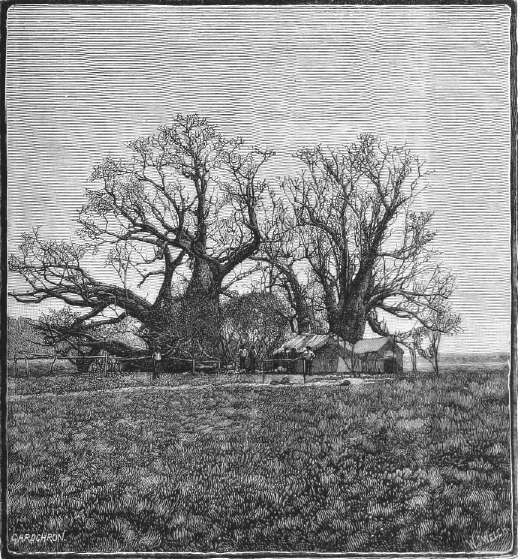
[In our last issue we gave an illustration of one of the giants of the vegetable kingdom in the shape of the African Baobab.1 This week we are enabled to represent its Australian brother, Adansonia Gregorii.2 It is a native of the sandy plains of North Australia, and differs from the African species, A. digitata, in its smaller fruit with a shorter foot-stalk. It was originally discovered by Mr. Gregory, who records that the largest tree seen by him was 85 feet in girth at 2 feet from the ground. The pulp of the fruit has an agreeable acid taste, like cream of tartar, which is very refreshing to the traveller. For our illustration (fig. 70), representing "a camp" of West Australian surveyors near Cambridge Gulf in the cool season of 1887,3 we are indebted to the kindness of Baron Ferdinand von Mueller.4]
Adansonia digitata
Adansonia Gregorii
The illustration was in a supplementary sheet to the issue of 21 April, with relevant text on p. 494.
The illustration is captioned 'Fig. 70.—the australian boab, adansonia gregorii.': 88-03-00a_image01.jpg
John Forrest undertook a survey in mid-1866, following one in 1883; see his account in Inquirer and commercial news (Perth), 4 August 1886, Supplement, p. 1, and it is possible that the Gardeners' chronicle has misinterpreted the date of the image. If the date is correct, it may refer to a survey to select the route of the telegraph line from Wyndham (Cambridge Gulf) to the Kimberly goldfields, for which construction tenders were invited by the WA Government in October 1887; see West Australian (Perth), 25 October 1887, p. 2.
The article concludes:
It would form the theme of an interesting discussion to inquire into the significance of the presence of two such nearly allied Bombaceous trees in such widely remote continents as Africa and Australia. The presumption of course is, that in some former state of the world's condition Baobabs or their representatives might have existed in the intervening countries where in consequence of changed conditions none now are found.
Letter not found. The text given here is from 'Australian baobab', Gardeners' chronicle, 28 April 1888, p. 521. It is dated to March 1888 as the latest likely date that it could have been sent, to have been reported in this edition.
Please cite as “FVM-88-03-00a,” in Correspondence of Ferdinand von Mueller, edited by R.W. Home, Thomas A. Darragh, A.M. Lucas, Sara Maroske, D.M. Sinkora†, J.H. Voigt† and Monika Wells accessed on