From William Fitzgerald to Ferdinand von Mueller 7 Feb 1896
I did not collect the specimens of the Banana, which grows on the Mambare-River.1 Mr. Butterworth, on the request of Sir William Macgregor,2 brought a spike on board. Height 15–25 feet; stem stout; leaves 8 to 10 feet in length, 2–3 feet across; spike (thyrsoid raceme) pendulous, 3½ feet long by the same (in largest) circumference (as regards the fruit masses seen); bracts broadly ovate (very acute, according to Mr. Winter's delineation3), 9–12 inches long, bright green.
Flowers numerous, ¾ –1 inch in length, white, the lobes of the calyx firm, linear, with sharply-recurved margins; corolla-lobes small, membranous; stigma trifid; fruit about 3 inches long by 1½ inch in diameter, outside pale yellow; pulp whitish, streaked with purple. Seeds 24–28; testa bony, black. Albument mealy, bitter. The fruit is not eaten by the natives, and is known to them by the name of Tubi.
Papua. See also N. Miklouho-Maclay to M, 4 September 1885.
See W. MacGregor to M, 15 December 1895 (in this edition as 95-12-15a).
Published in Gardeners' chronicle, 17 October 1896, p. 467. 96-02-07_image01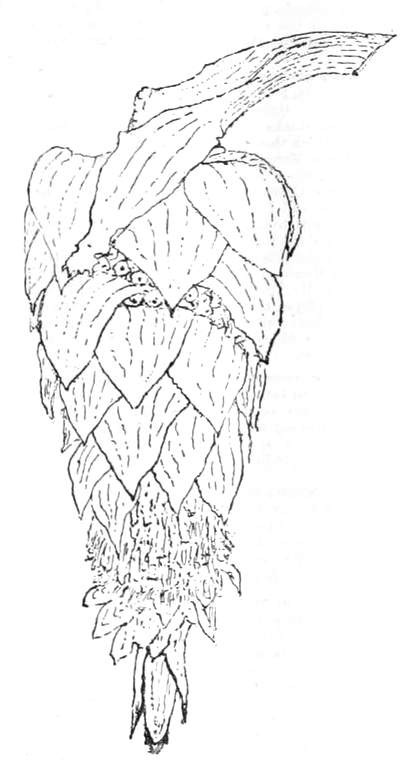
Letter not found. The text given here is from 'Remarks on a wild Banana of New Guinea', Victorian naturalist. vol. 13 (1896), p. 53 (B96.08.01). The quotation is introduced by: 'From Mr. Fitzgerald's notes, forwarded by him from Cooktown on February 7, 1896, and now given with some alterations in the organographic words, I extract as essential the following:—'.
Please cite as “FVM-96-02-07,” in Correspondence of Ferdinand von Mueller, edited by R.W. Home, Thomas A. Darragh, A.M. Lucas, Sara Maroske, D.M. Sinkora†, J.H. Voigt† and Monika Wells accessed on