From Ferdinand von Mueller to the Australasian 15 May 1896
We have, [Baron Mueller writes] 1 a similar saltbush on our coast, the A. cinereum, but it is too saline to be relished by pasture animals, though it could be utilised for stable fodder mixed with much other feed.
The third of the three principal shrubby salsolaceous shrubs of great pasture value reaching our colony from the interior is A. nummularium, passing under the curious vernacular, ' Old Man Saltbush,' and truly it is grey enough. Among the half-shrubby species of Atriplex indigenous here, the A. semibarcatum2 has suddenly obtained a marvellous fame in California, after a suggestion of mine to try it on the forbidden 'alkali land,' where not even a native plant would grow, and which, therefore, since more than 300 years of occupation of California, remained valueless. From small quantities of seeds which I sent in my cosmopolitan interchanges to California, the A. semibarcatum (which proved for the particular chemic constitution of the soil of the alkali land much better adapted than any other of our salsolaceae), now tons of seeds are raised annually for Utah, Arizona, and other states, and every proprietor glorifies now in alkali land, while before he concealed having such within his estate as deteriorating its value. Tempora mutantur!
But the gigantic scale at which A. semibarcatum is propagated In Western North America applies quite to A. halimoides, A. vesicarium, and A. nummularium in Africa. The French, after initiatory steps of mine have taken it as far as the Sahara and the Senegal,3 and British ruralists raise also the seeds by bales for further distribution in South Africa,4 carrying it into the tropical regions. Where these plants are reared it is not necessary to give rock salt to sheep. An extensive export trade in saltbush seeds has arisen here now in our metropolis, and this should lead to disseminate these important pasture plants over numerous runs in Australia on which they do not exist, or to sow them methodically where they have been fed out. In looking on the ten Decades of the Salsolaceous Plants5 it might appear that these remarkable forms of vegetation played an insignificant part in our rural economy. But it is the reverse. They endure our scorching heat, live without rains, are liked by all kinds of stock, prove nutritious and wholesome to them, are easily raised from seeds, and can with some little care also be propagated from cuttings. As some are confined to one part of Australia, and some to others, as can be seen in my Census of Australian Plants,6 it seemed to facilitate the proper choice from among about 100 species to have a work for permanent easy reference. This should be acquired by all our mechanics' institutes and free libraries, and the plates will serve also as instructive patterns at drawing schools. The work has by permission been dedicated to Lord Hopetoun, and recognises the rural proclivities of this enlightened nobleman.7
Atriplex cinereum
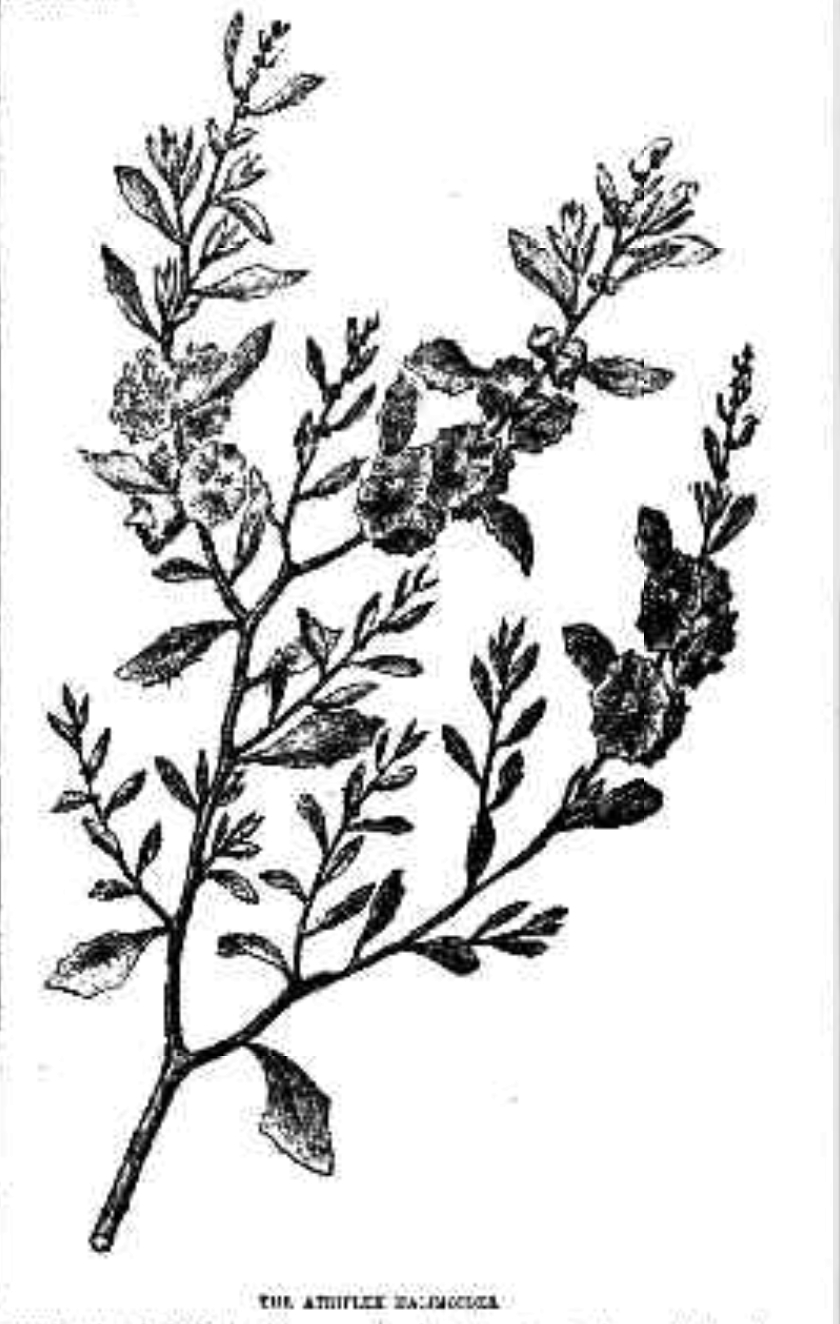
Atriplex halimoides
Atriplex nummularium
Atriplex semibarcatum
Atriplex vesicarium
Salsolaceae
'Baron von Mueller writes' interpolated by the journalist in the text quoted following the introduction, which may have been paraphrased from M's account:
'The Atriplex halimoides was discovered daring Sir Thomas Mitchell's first expedition, about 60 years ago, and reaches as a native plant the N.W. parts of our colony, as shown in Baron Von Mueller's report of 1854. With A. vesicarium it constitutes mainly the gregarious "saltbush" vegetation of some tracts of Riverina, the main features on the horizon being these two never very high shrubs'.
M's cited report of 1854 (B54.10.01) comments (p. 3) that his examination of the area along the Murray river as far as its junction with the Darling river, meant that 'the materials for the Flora of Victoria became at this time considerably augmented, more particularly in the natural orders of Compositae and Salsolaceae. The saltplants here alluded to contribute largely to render these desolate places fit and often preferable for sheep pastures.' However, the appendix listing plants 'examined between September, 1853, and October, 1854' does not include Atriplex halimoides as one of the three Atriplex species listed.
This item is treated as a letter, although it may have been a solicited article.
The text is illustrated by a figure of Atriplex halimoides, based on plate XIX in B89.13.04, but without the detailed images of components of the flowers and fruits: 96-05-15a_image01.jpg
Typesetter's error for semibaccatum?
See M to the Société Nationale d'acclimatation de France, October 1885 (in this edition as 85-10-00e), M to L. Dejardin, 6 November 1889.
M supplied Peter McOwan at the Cape Colony, see notes to M to the Editor of the Indian Forester, 24 June 1893 (in this edition as 93-06-24c).
Only nine decades were published. B89.13.04 includes Decades 1 and 2; decade 9 included in B91.13.24. In M to the Gardeners' Chronicle, September 1896 (in this edition as 96-09-00d) he announced his intention to complete the series.
B83.03.04; second edition B89.12.03.
Governor of Victoria 1889-1895; 'Hunting was his one hobby; a fearless rider' (ADB).
Letter not found. The text given here is from The Australian Saltbushes, Australasian (Melbourne), 23 May 1896, p. 968 (B96.05.07). On the assumption it would have been published in the next available issue it is dated to 15 May 1896, as the latest likely date that it could have been written.
Please cite as “FVM-96-05-15a,” in Correspondence of Ferdinand von Mueller, edited by R.W. Home, Thomas A. Darragh, A.M. Lucas, Sara Maroske, D.M. Sinkora†, J.H. Voigt† and Monika Wells accessed on