From Ferdinand von Mueller to the Leader [June 1896]
[Solanum Nigrum. — Since the publication in The Leader of an engraving of this plant1 several communications have appeared describing this British annual nightshade as not dangerous.2 It may be well, therefore, the Government Botanist begs us, to point out that when Desfosse, in 1820, discovered the Solanin,3 it was prepared from the berry of this plant, but he found this alkaloid subsequently also in the leaves of other species. This Solanum had already been known to Theophrastos more than 2000 years ago to be narcotic, and he gave it the ominous name Strychnos, under which it occurs in the works by Dioscorides and other ancient physicians, who used the plant medicinally. Baron Von Mueller has for many years been aware that the berries have been eaten without ill effects,4 but asks how many by any person at any one time? They are so small that a dozen of them only equals a good sized gooseberry. In cases again where the foliage may have been used as a kitchen vegetable it may be assumed that the poisonous principle has been removed in the boiling water. In the case of pasture animals, however, they would feed on the herb in its raw state, and no wonder therefore that fatal results should take place, especially if the animals browsed on the plant extensively in autumn when the pastures are bare. The fatal cases reported recently are not the only instances of deaths among herds and flocks, many others having quite lately come under the Government Botanist's notice. It is very likely, that officer remarks, that the deleterious particles in this plant may be at times hardly developed. A professional gentleman, holding a public position in a neighboring colony, announced officially some years ago, that he had fed pasture animals without bad results on even the Euphorbia Drummondi from which in our interior regions so many animals succumb. The bitter almond and the sweet are varieties of the same tree. For expert mental5 purposes sheep have been fed on the gastrolobium bilobum, one of the worst of the poison shrubs of West Australia, the foliage at one period of the year producing no ill effect. In his work on select plants Baron Von Mueller gives those species of Solanum of which the berries are always free of danger as esculents.6 The four chemical elements, which form the alkaloids, carbon, hydrogen, nitrogen, and oxygen, unlike those of mineral poisons, are always present, and in their varied proportions do not get always developed in the same process. Nevertheless we should be extremely cautious, so far as poison plants ago concerned, to declare them innocuous. In the case of the two little children who ate the berries of the English nightshade, it was needful for a medical practitioner to watch them for some time before so tender beings could be declared out of danger.7 The Atropa Belladonna seems nowhere yet naturalised, and the Government Botanist has discouraged the culture of this plant and of the Hemlock, Henbane and some other very powerful medicinal plants to guard against their becoming spontaneous here. Sir James Smith, a leading physician of his time, remarks in his English flora that merely "a grain or two of the dried leaf has sometimes been given to promote various secretions, possibly by exciting a great and rather dangerous agitation in the viscera."8 Professor Husemann, a leading therapeutist of the present day, observes9 that Solanin, which is particularly abundant in potato shoots, is a deadly poison to domestic animals, even in very small doses, as ascertained by his special experiments.]10
Atropa Belladonna
Euphorbia Drummondi
Gastrolobium bilobum
Solanum Nigrum
Strychnos
Leader, 16 May 1896, p. 12: the 'illustration is drawn from a sketch furnished to us by Baron von Mueller'. 96-06-00c_image01.jpg
M evidently provided access to Hayne (1805-37), vol. 2, tab. 40; the Leader illustration is a very close copy of the coloured plate but lacks an explanation of the numbered detailed drawings of dissections.
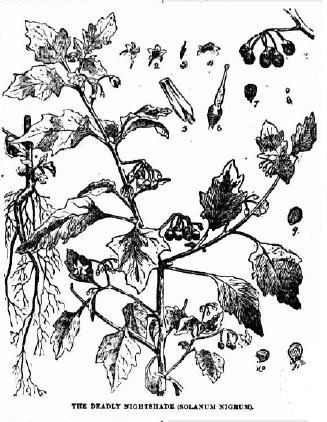
There were several letters to the Editor of the Argus, which had on 8 May 1896, p. 6, published a letter from H. Sugden Rudduck, of the Veterinary Hospital, on the poisonous qualities of the British annual nightshade Solanum nigrum. Ruddock's letter was previously published in 'A poisonous plant', Age (Melbourne), 24 April 1896, p. 6, and
accompanied the engraving of the plant in the Leader, 16 May 1896, p. 12. The 'Along the track' column the Leader, 23 May 1896, p. 11, commented on some of the letters to the Argus.
Desfosses (1820).
In letters to the editor, G. Selby (Argus, 14 May 1896, p. 3) and D. M'Alpine (Argus, 20 May 1896, p. 6) each reported that eating the berries produced no ill effects.
Typsetter’s error for experimental?
The current edition was B95.08.04: see pp. 507-12 for a number of species, including tomato, potato and eggplant.
The Leader article of 16 May that included the engraving of Solanum nigrum also carried a report of two children eating the berries, and there was a similar account of another case in a letter to the editor of the Argus, 22 May 1896, p. 3.
The quotation is from J. E. Smith (1824-8), vol. 1, p. 318.
Husemann, Hilger & Husemann (1882-4), vol. 2, pp. 1154-5.
See also M to Australasian, June 1896 (in this edition as 96-06-00b).
Letter not found. The text given here is from 'Live stock notes', Leader, 6 June 1896, p. 10.
Please cite as “FVM-96-06-00c,” in Correspondence of Ferdinand von Mueller, edited by R.W. Home, Thomas A. Darragh, A.M. Lucas, Sara Maroske, D.M. Sinkora†, J.H. Voigt† and Monika Wells accessed on