From J. V. Carus 21 March 1876
Leipzig
March 21st. 1876
My dear Sir,
I come with a new difficulty. In your book on Coral-Reefs you say p. 70. l.8 from bottom “this would give to the reef a somewhat greater vertical thickness than would otherwise be possible.”1 According to my opinion it ought to be “a somewhat greater horizontal extent.” You say a few lines previously, that the coast-land is gently inclined and the soundings indicate an equally gentle slope beneath the water; there is no reason for supposing that the basis of the reef lies at a greater depth than at which the pollypfers2 could begin constructing the reef Some allowance must be made for the outward extension of a foundation formed of sand and detritus; and this would give to the reef a greater—vertical or horizontal? extent. The foundation cannot be added to the vertical thickness of the reef, which rests on it by this foundation the level of the basis is brought to that depth at which the polypfers could begin constructing the reef
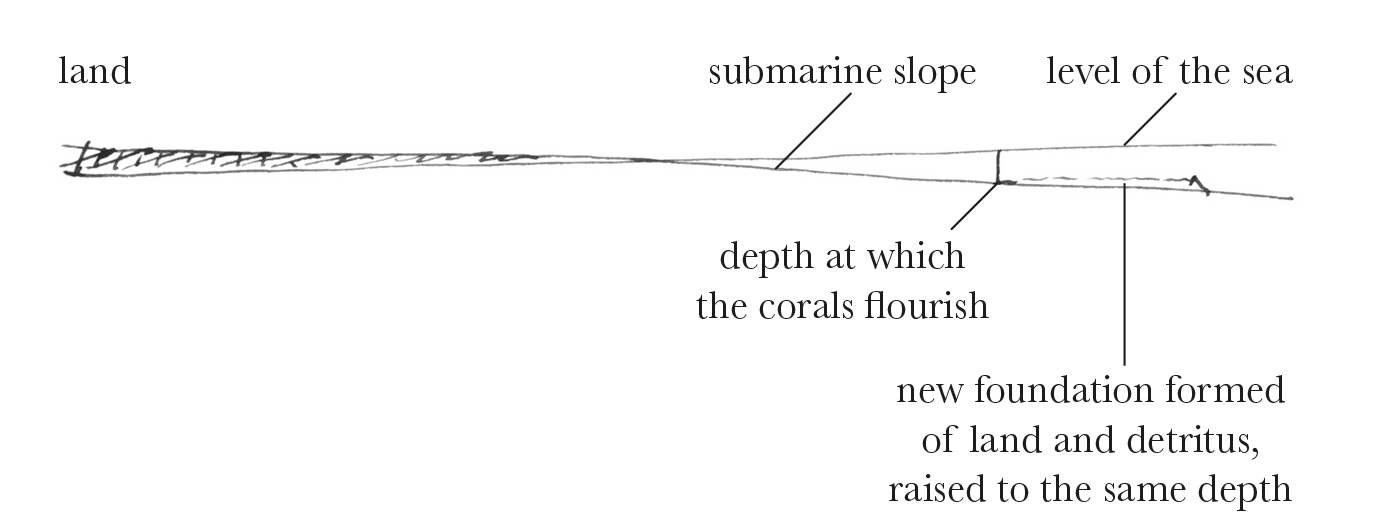
Thus the horizontal extent of the reef is increased, but not, as far as I see the vertical thickness.
p. 68. footnote, you spell Dr. Allen, but on p.20 and 79 Allan.3 Which is right?
p 66. l. 13. read basal for basalt.4
Begging your pardon for troubling you anew I am | Yours very sincerely J. Victor Carus
Please cite as “DCP-LETT-10423,” in Ɛpsilon: The Charles Darwin Collection accessed on