My dear Father
Now that I am not experimenting I never know the date so don’t swear at me for putting Sunday—
I have been rather alarmed by reading the report of Kraus’s experiments in the last Bot Zeitung, in which he shows the increase of water in the convex side together with variations in the amount of sugar and acid; it looks so horribly like variations in turgescence on the two sides.2 It makes me doubt whether I havn’t been too bold in saying what I have about Phycomyces; I mean whether I havn’t made too much of a hypothesis on the basis of these experiments. I have said nearly the same as I did in the English M.S. namely that the turgescence theory wont do for one celled organs, and that as we have no reason to assume two kinds of growth it is simpler to believe that each cell acts as a unicell organ in multicellar plants— Also that as a unicellr thing can circumnutate it is possible that a multicellr thing does so by means of its individual cells.3 Are you sure this isn’t too much to say?
It is rather amusing about Wortmann’s Mucor stolonifer, he first of all described it as circumnutn but when he heard of mine & saw the figures he was frightened & struck it out.4 I have seen the Mucor, it is the most extraordinary thing I ever saw, it moves about like a worm hunting for something, it moves so quick it is hard to believe it is a plant;5 he might easily have given a few sketches to show the kind of changes but he seemed to think it wasn’t necessary; I think it goes in irregular circles, & must be true circumnutation I can show it you at Down as it is the little beast that bothered me so in my Phyco cultivation.
De Bary made a pretty “Spitz und Basis” Vöchting experiment unintentionally,6 he put some cress seedlings cut off above the level of the ground and having cotyledons & perhaps one pair of leaves, under a bell glass; (I think it was to supply oxygen to a mould); the hypocotyl bent up so
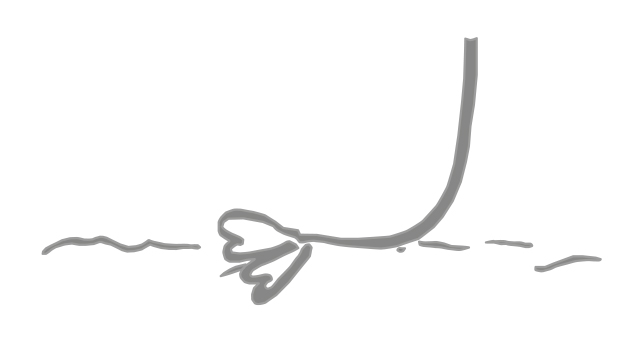 that the cut end rose apogeotropically, and in a day or two roots came out so:—
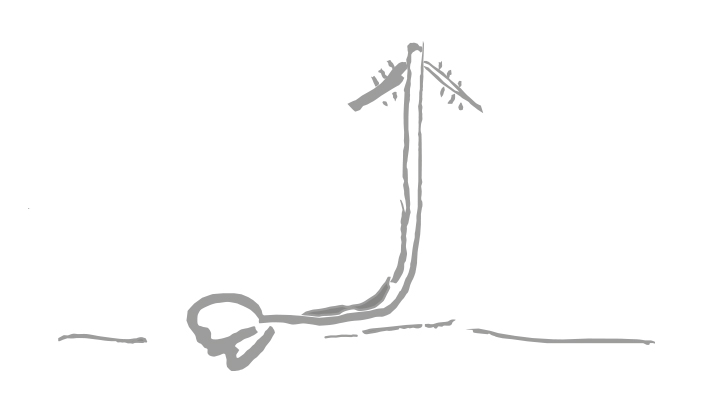 ; if this would always succeed it would be a delightful way of making cuttings; we have sowed a lot of cress on the klinostat so that we may try it again with certainly no Nachwirkung;7 I am trying my willow cutting experiment on the klino but I am afraid the shoots wont be grown enough. He seemed to think my bramble experiment good as opposed to Sachs’s root stuff &c which he thinks great bosh.8
Tell Ubbadub I saw too different Uhlans today one with pink cuffs & collar & the other with white, & they looked very pretty but they had their coats buttoned up so they hadn’t got pretty fronts to them like the Uhlan going to church9
Your affec | F. D.
Please cite as “DCP-LETT-13220F,” in Ɛpsilon: The Charles Darwin Collection accessed on