From Jeffries Wyman 11 January 1866
Cambridge [Massachusetts]
Jan. 11th. 1866
Dear Sir
Having lately given some attention to the study of the cells of the bee I have been struck with the fact that the deviations from the form alledged to have been measured by Maraldi & which was calculated by Koenig, are much greater than is mentioned in any of the descriptions I have seen.1 The conclusion to which I have been led, is, that whatever the typical form of the cell be, it is rarely, if ever, realised.2 As you have given your own careful attention to this subject, I feel that I run the risk of writing what may be already better known to you than to myself.3 Then it occurs to me that cumulative evidence is worth something. At all events I will state what I have to say briefly.
1st After repeated measurments of hundreds of worker cells I find, as Reaumer did in the drone cells, that the diameters are very frequently variable, so that nine cells measured in the direction of one diameter will sometimes fill a space, which it will require ten to fill if measured in the direction of another.4 2d. The terminal rhombs are the most variable parts of the cell. I have shown this very satisfactorily by means of plaster casts, & even by the coccoons from old brood cells which give a very good model of the base— Sometimes the rhombs are all of different sizes, & at others one is nearly eliminated, the other two making nearly the whole of the partition between two adjoining cells. 3d. The introduction of the fourth side to the base does not always, or even generally depend upon the transition from worker to drone cells, as stated by Huber,5 but either upon an incorrect allinement of the cells on opposite sides of the comb, or upon an increase of the size of the cells on one side not corresponding with that on the other. 4th the most remarkable deviation which I have noticed is a sort of rotation as it were of the cells, so that those of the two sides, differed in position about 30o.
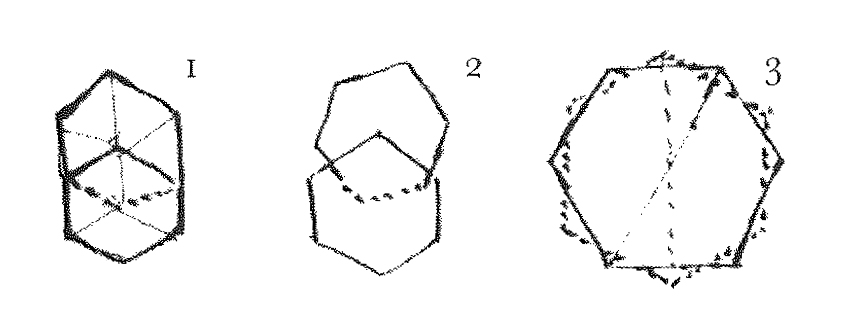
Fig 1 being the normal position, 2 & 3 are the abnormal ones— in 2 the angle of one cell corresponds with the centre of the other, but instead of pointing to one of the angles of the other cell it points to one of the sides. In 3 the cells were fitted together by their whole bases, &, projected on to the same plane, are concentric. In both of these cases the rhombic faces became impracticable, & the bees compromised on a flat bottom to the cell— I found this arrangement in a large part of a worker brood-comb, & in the whole of a piece of drone comb. 5th. Lastly there is no regular mode of transition from worker to drone cells, but this may be effected in several ways, viz by means of irregular polygonal cells, by a gradual change of size, so that no line of separation is noticeable between the two kinds; & by the close approximation of worker & drone cells making an abrupt change; but as the worker cells are one fifth smaller than the drone cells, & therefore fail to fill up the space, a new row is intercalated for this purpose.
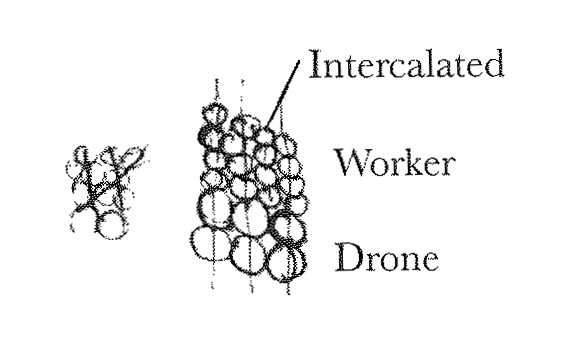
These intercalated rows however do come at regular intervals, & the emergency is often met by thickened walls.
I have studied the cells with reference to the hexagonal shape, & it seems to me that the view taken by Mr Waterhouse & yourself is the most tenable one.6 Fearing that you may not have seen the work, I take the liberty of calling your attention to the so called “fossil tadpole nests”, in Prof Hitchcocks report on the Ichnology of Massachusetts. Have you not there exactly the phenomenon in question? A lot of tadpoles get together each wiggling about on a centre, as is is necessary in a crowd, each excavates a place in the mud, but their respective cavities soon come in collision & a flat wall between them results, & in many cases a hexagonal cell almost as true as that of the bee—7
One thing seems entirely clear, that the hexagonal cell results from the cooperation of several bees & is never made by a single bee, & if he have no antagonist in the construction of a wall it is curvilinear.8 In some of my wasps nests from S America it appears that even in working with paste board, the outer walls of the new cells are always curved at first, but when other cells are made outside of them they are flattened so as to conform to those that have preceded them.
Before I close allow me to mention the observations of Mr Putnam on the cells of our humble bees—which he has shown are at first a mass of pollen & honey, on which an egg is placed, & into which the larva eats as soon as hatched.9 The cavity thus formed is the beginning of the cell.— This is increased by additions of pollen, which is gradually consumed; eventually wax is applied to the exterior in a very thin layer.10 I requested Mr Putnam to send you a copy of his paper, which perhaps you will have received before this reaches you.
I fear I have trespassed upon your time, but hope you will excuse me on the score of good intention
With great respect | Truly yours | J. Wyman
Charles Darwin, Esq. | Downe Bromley Kent.
CD annotations
Please cite as “DCP-LETT-4974,” in Ɛpsilon: The Charles Darwin Collection accessed on