From C. S. Bate 7 April 1868
8, Mulgrave Place, | Plymouth.
Apl 7/68
My dear Sir
The paper on the Dentition of the mole is in the “Transactions of the Odontological society of Gt Britain” for 1867— Until reading your recent work I knew not that you felt an interest in Pathology I therefore send you a copy of another memoir that I published some time since in the same Society’s Trans—1
While on the Subject of teeth may I ask If in the case of double tooth to which you refer page 2/391 you mean a molar tooth.2 If so I would suggest the following for your consideration— The incisor teeth frequently are developed with a small tubercle behind thus
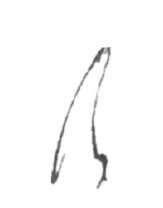
This is sometimes developed to so large an extent as to form what might be called a double tooth thus
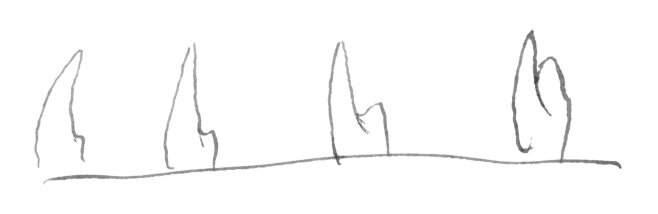
I have seen it quite as much as this last I am inclined to think that this is the character of tooth your informant meant, which is not uncommon, & to a certain extent is hereditary. The word double by the popular expression for a molar, misleads and as I am inclined to think has misled yourself:— am I right?
| Porcelana | longicornis | } | has chelæ unequal in both sexes but larger in males, |
| " | platycheles | ||
| " | in longicornis much so: | ||
| Cancer | paposus: | equal in female but occasionally unequal in both sexes but most so in males & larger | |
| Enymone | aspera— | equal in both sexes both much longer & larger in males | |
| Corystes | cassivelaunus— | equal in both sexes very much longer in males Bells figure is that of a male | |
| Gonoplax | bispinosus, | equal in both sexes, longer in male.3 | |
The smaller chelæ is larger in males than in females generally, only on the principle that the animal is larger, that is when the chelæ are unequal— If the males & females are of one size & the claws unequal the smaller claw generally resembles that of the female— when the chelæ are right & left equal, & larger, the claw of the males generally differs in form from those of the females.
I think if you wish it, with but little trouble, I could give you a longer list but of course in so doing I should have in some instances to depend upon the authority of others
Believe me yours very sincerely | Yours C. Spence Bate—
P.S | I am now drawing up for the Zoological society the description of what I believe to be a new genus of Prawn— It is a freshwater genus4 The largest that I have is 9 inches long besides the chela which is 10 more— The claws are equal but immensely long & so formed that the nippers cannot be brought to reach the mouth. Strange to say that the species are very close in their resemblance to each other though one comes from the Ganges,—one from Central america, one from Formosa, & one unknown (perhaps Mauritius).5 the repetition of species under similar conditions in various parts of the world is very remarkable
CD annotations
Please cite as “DCP-LETT-6101,” in Ɛpsilon: The Charles Darwin Collection accessed on