From George Busk 10 March 1871
32 Harley St
Mar 10/71
My dear Darwin
As it seems to me that you have fallen into some misapprehension with respect to the supra condyloid foramen in the human Subject (p. 28) I hope you will not take it amiss if I call your attention to the point.1
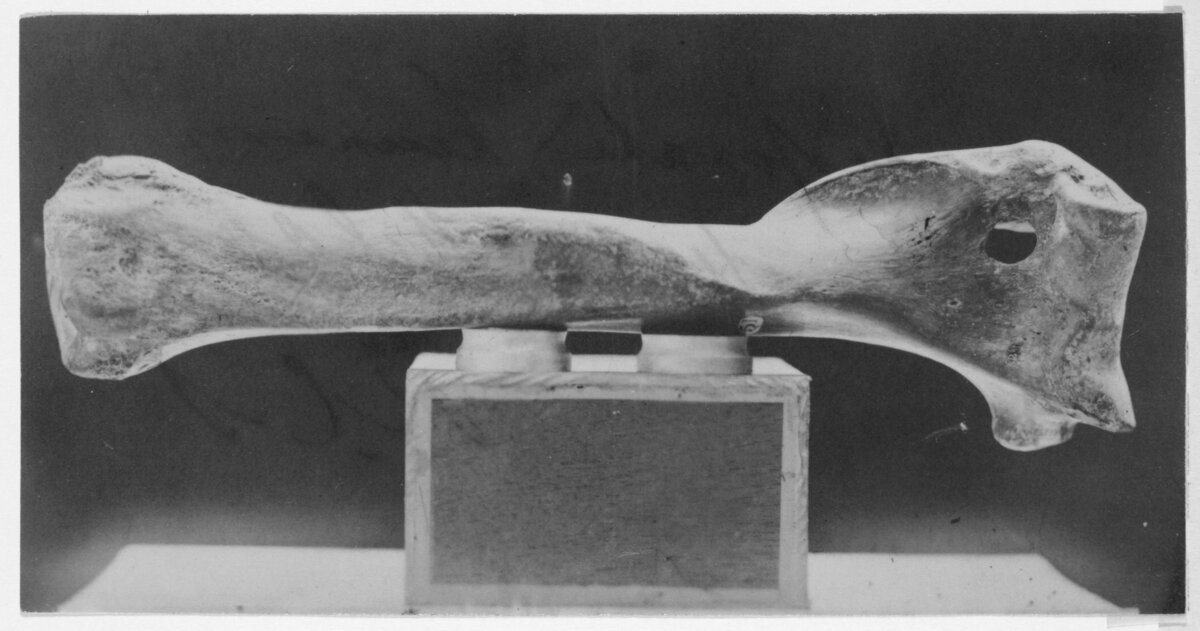
The true supra condyloid foramen or more properly canal, as it exists in the Felidæ and some other animals is formed by a process or bridge of bone extending from the internal condyloid ridge to the epicondyloid eminence and thus forming a canal through which the median nerve & in some cases an artery and veins pass, whilst the operus bridge itself affords an additional surface for the origin or attachment principally of the pronator teres muscle.2 It may therefore be regarded as of some functional importance, but that it has no genetic significance3 seems tolerably clear seeing that it occurs in a variety of animals belonging to widely different orders and families, but all, animals more or less distinguished either as active carnivores with powerful talons, such as the Felidæ—or as diggers & burrowers—as the Mole Badger Weasles—Anteaters &c; or as swimmers as the Otter & Common Seal; or as active climbers, as some few tailed monkeys Lemurs (I believe) Loris, Tarsius4 &c—all animals whose habits demand great powers of pronation & flexion in the fore paw. It is not improbable that in the Marsupials so many of which possess this canal it may have some genetic significance, but I think that even in them also it will be found to be more of a functional character.
In the human subject this operus bridge is represented by an intermuscular tendinous or aponeurotic band occupying the same position & in like manner affording origin in part to the pronator teres muscle & to one of the carpal flexors. And it would seem that in some rare instances this band may become partially or entirely ossified, when it would represent both functionally & morphologically the osseous process of the Felidæ &c. Its occurrence therefore in Man would not appear to be of any morphological importance; and would merely serve to indicate that the individual, had, in all probability and unusually well developed pronator teres &c. Whether this would give any advantage in the struggle for existence I cannot say—but I should apprehend that it has not yet done so, since the occurrence of the canal in Man is extremely rare, and has not, so far as I know, been observed to prevail in any particular race of Mankind.
The supra condyloid perforation referred to in my Account of the Gibraltar Caves and noticed by M. Broca in the quotation you cite is a totally different thing, and if possible of still less importance in any point of view.5 The perforation is produced simply by a deficiency of bone at the bottom of the olecranon-fossa at the point where the septum between that fossa & the Coronoid fossa in front is naturally little thicker than paper. Of course as this perforation is in the middle of the articulation & within the capsule of the joint no vessel or nerve can pass through it—so that it has neither functional nor morphological significance— It is constant I think in some animals but in most it appears to be of only occasional or accidental occurrence as in Man; and it may exist on one side & not on the other as in the instance of the opposite humeri of U Spelæus from Gaylenreuth in the College Museum.6
In some instances, however, as in the caves in Algeria explored by Genl Faidherbe and M. Bourgignat the perforation may occur in such a large proportion of the ursine humeri, as almost to justify its being regarded as a race character, though certainly not of specific importance as it has been considered by M. Bourgignat in his Ursus Faidherbianus.7 How far it may indicate affinity of race in the human subject as in the Guanches, Bushmen & the priscan people noticed by M. Broca I cannot say.8
I have enclosed a fragment of the humerus of a Rabbit showing the perforation referred to by M. Broca & myself & also a figure of the humerus of U. Spelæus to which I have alluded, and if you compare these with the humerus of a Cat or Badger &c—you will at once see that it has no relation whatever to the supra-condyloid foramen or canal
Yours very truly | Geo: Busk
CD annotations
Please cite as “DCP-LETT-7563,” in Ɛpsilon: The Charles Darwin Collection accessed on