From William Preyer 8 May 1871
Jena
May 8, 1871
Dear Sir,
I am very thankful to you for your kind letter and the intended present of your “Descent of man.”1 But I am in possession of the book now. Only it took such a long time before I got it that I have not even yet finished reading it. We are here delighted to see that you hesitate not freely to follow up the theory to it’s last consequences. This is far more difficult in England than in Germany.
I enclose a few lines of Professor W. Müller and send his book with this letter.2 He wishes me to mention that his researches—not least the pathological part on epithelioma—adduce many new facts and arguments in favour of your theory. He began them four years ago and is now pursuing his studies on comparative embryology.
I cannot affirm that all negroes have no ear-lap.3 But Gegenbaur4 lent me two negroes ears where there is no trace of it to be found. I shall have them photographed
Hyrtl says that only the human ear has an ear-lap and this I found to be correct, as far as my knowledge reaches.5 But I shall soon get a hedge-hog.6
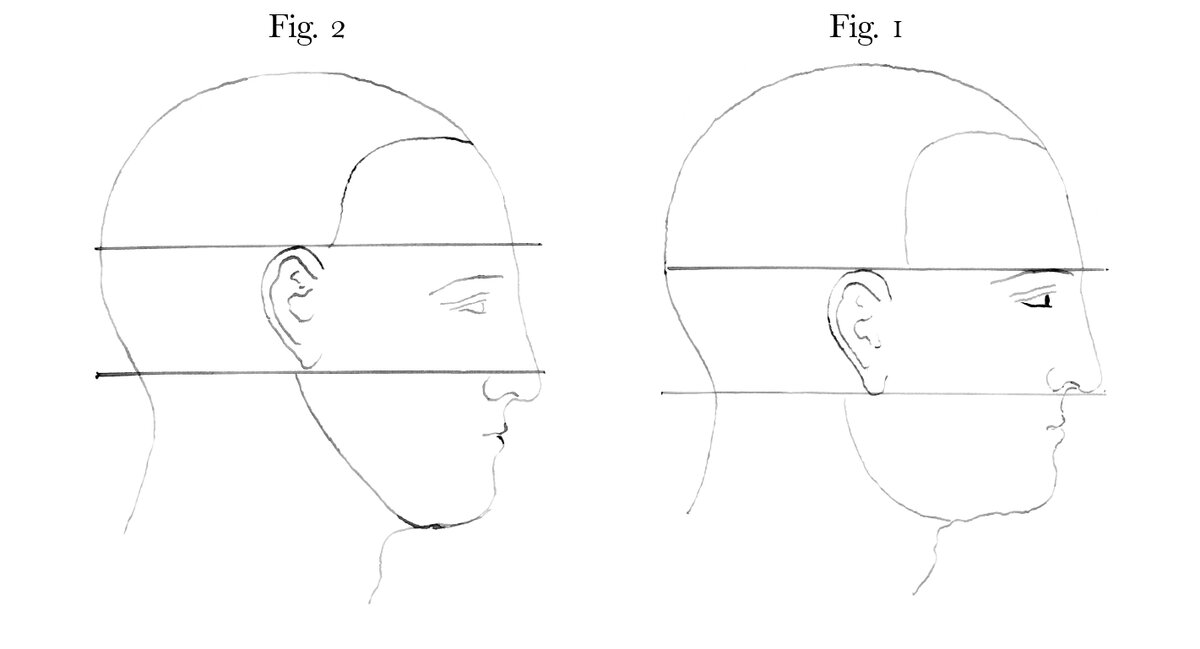
In Egyptian mummies I remarked some years ago at Paris a peculiarity in the position of the ear. It is situated higher up than in Europeans. Fig 1 being a modern European profile, Fig. 2 would be the same with the ear elevated as in ancient Egyptian profiles.7 Now I have never seen in civilised company anything like Fig. 2. But apes shew the same position of the ear. I find all Egyptian paintings and sculptures (2000 B.C. and backwards) have only the profiles with the ear higher up.
Now I should very much like to know whether any existing race has this peculiarity and whether you think it might be considered as a connecting link, because all mammalia have the ears standing higher up than man.
It was interesting to me to see that Rubens in his beautiful picture in the Dresden gallery gives the satyr pointed ears.8 The ear is very large but human with the only difference that it is pointed
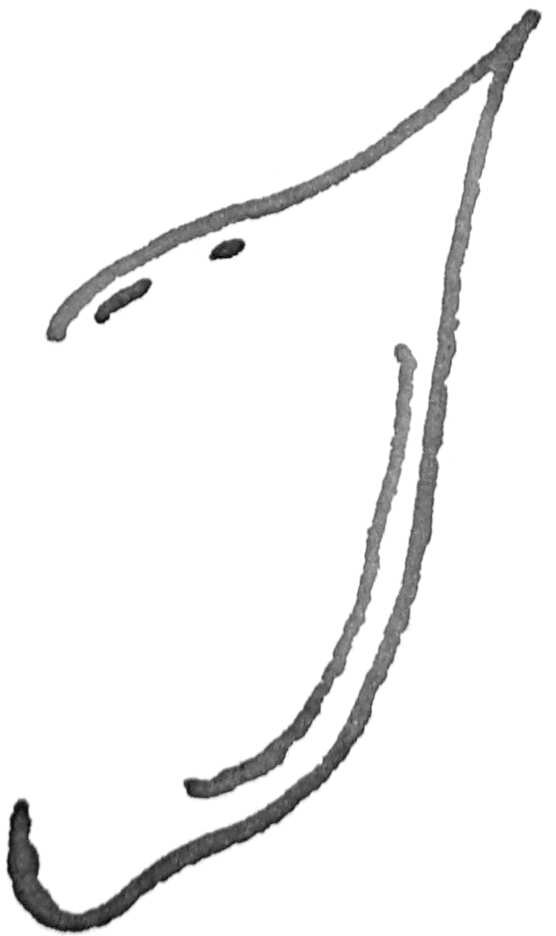
The artist’s imagination in this case seems to have anticipated the result of scientific inquiry.
With regard to the human ear Mr. E. Ray Lankester whom I have the pleasure of seeing daily thinks it possible that the ear-lap might have been acquired/produced artificially and developed by sexual selection. I suppose you have seen in South-America (Botocudos) enormously enlarged earlaps?9
Believe me, dear Sir, | your’s truly | Preyer
[Enclosure]10
CD annotations
Please cite as “DCP-LETT-7745,” in Ɛpsilon: The Charles Darwin Collection accessed on