Faraday report 30 September 1861
Royal Institution 30 Septr 1861.
Report on Prossers lime light at the S. Foreland Upper light.
On the 25th instant I left London for Dover, and returned on the 27 my object being to visit the Prosser lime light which has been placed in the South Foreland upper lighthouse & examine it both by night & by day. The lamp has been placed in the center of the Fresnel apparatus which has already been employed with the Electric light and which is adjusted to the use of a 4 wicked oil lamp the burner of which 3¾ of an inch in diameter[.] The present lamp consists of a central octedral prism of quick lime built up of many small pieces of lime from chalk: it is about 3⅝ inches in diameter and 16 inches long: it is supported by a clock which when in action lifts it perpendicularly at the rate of 1 inch per hour. Eight gas jets conveying mixed oxygen & hydrogen are placed at equidistances around this lime in a horizontal plane[.] When the gases are lighted and directed against the lime they produce eight places of intense ignition and as the lime core is about 11.4 inches in circumference the centres of these 8 flames are about 1.4 inches apart[.]
Each flame has a shape like that in the margin
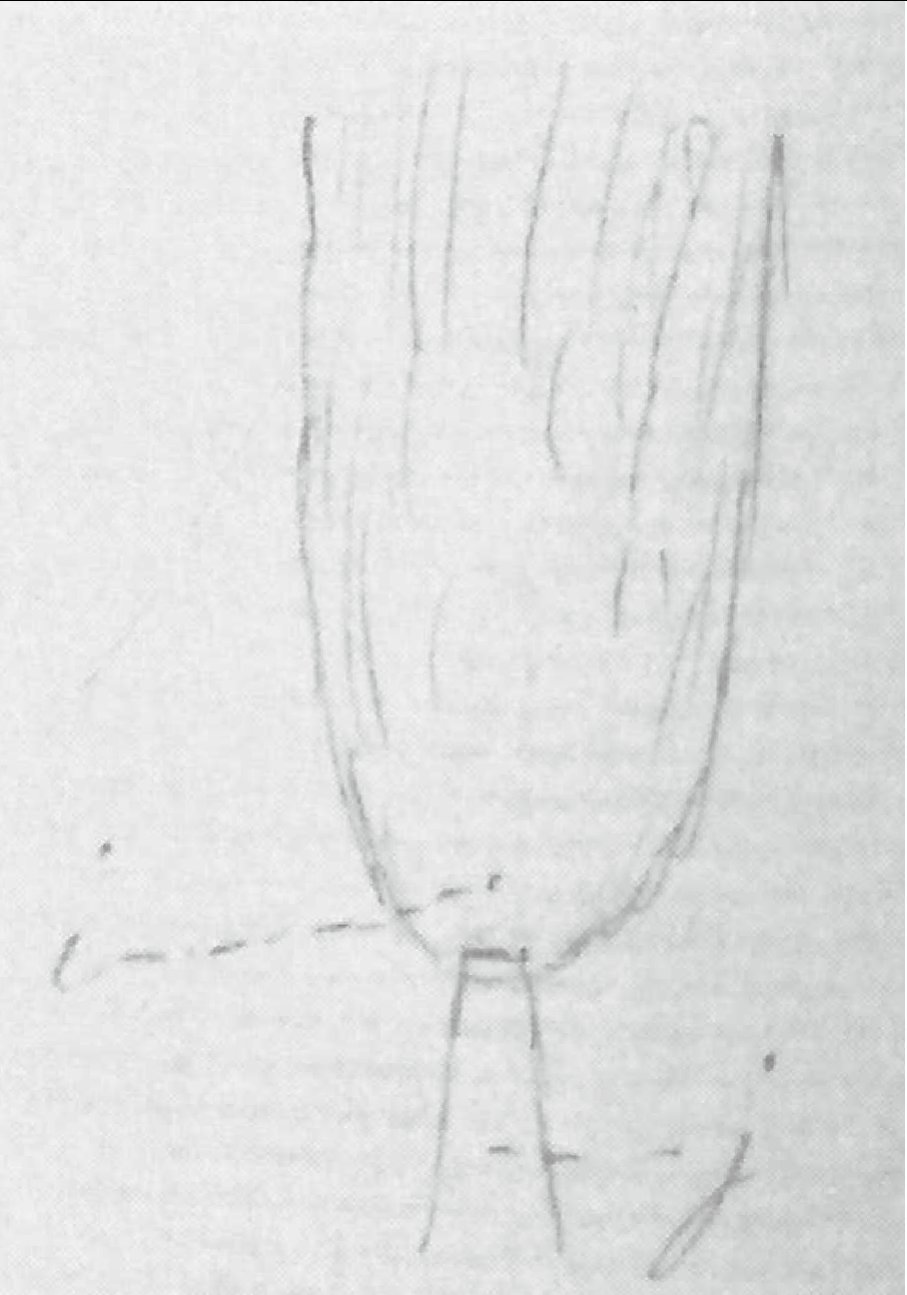 the place of most intense light is nearly at i the intensity
diminishing from it in all directions - j is the gas jet which is 1/6 to ⅛ of
an inch from the lime. So that the whole lamp may be considered as consisting
of the 8 flames placed round a circle 11.4 inches in circumference[.]
It will be seen that these flames differ from a common flame in that they cast no light backward[.] A lamp flame looked at in a horizontal direction sends forth an equal intensity of light all round. A lime light flame is most intense in front; looked at obliquely either sideways upwards or downwards it becomes less intense; looked for from behind it gives no light in that direction. With a cylinder of lime about the size of my thumb and heated by two jets on opposite sides the light in the front of one jet was about the same, as nearly as I could judge, to the light from the two jets looked at from the intervening position[.] If the light had been produced in a plane surface it would have been lost of course at 90° round from the front direction.
The lamp practice in the lanthorn is very easy - the jets are easily & safely lighted & adjusted. The action then goes on for hours together without change. The clock varies the lime - droughts do not affect the light - there is apparently no circumstance present which can cause derangment, and as far as appears by theory or practice, the lamp might be left until sun-rise untouched, provided gas were regularly supplied from below[.] The lamp is easier of management than a common oil lamp. It is easily replaced in case of need by the ordinary oil lamp; & that has been done in times varying from 7 minutes to 10 or more[.]
The light produced is very white & beautiful in character; far surpassing that of oil or gas flame in its intensity, but not equal to the Electric spark: but then it is much larger in dimension[.] It is as the light of a planet whereas the electric light is like that of a star. It streams out from the lanthorn over the surrounding space in great abundance.
Consider a single flame. The jet of gases cuts a little depression in the lime so that the place of maximum light is always in a shallow hollow. The rays which go horizontally forward are the most intense;- those which rise diminish in intensity the more they rise: those which descend diminish even more rapidly than the former & are obstructed a good deal by the jet:- so that the best rays are received on the dioptric part of the apparatus, & the weaker rays on the reflectors above & below[.] If the maximum ray which issues from the bottom of the flame be sent to the sea horizon through the dioptric or lens part then all the light from the part of the flame above will be sent on to the sea & that will be an advantage:- but as regards the reflectors, upper & lower, all the light from that same upper part will be sent to the sky. In respect of the issuing rays it is to be remembered that they do not come from a body of flame like that of four concentric wicks but from a single ignited surface having no depth.
Then again considering the issue of the light in a horizontal plane it is not the light which comes from a single point as the electric spark or that from a section or line continuous for 3¾ inches as that of an oil lamp but from a horizontal line of lights[.] Though there are 8 lights, never more than four can be seen at once: & in other directions only three are in sight. Because of the more direct view of the three they probably give as much light as the four.- When four are visible the two extreme lights are by comparison with the other two feeble, because of their obliquity;- and even when all the lights are accurately equal in power they will never appear to an eye at a distance as equal to each other, except in the case of four light visible, when those of equal obliquity will appear of equal intensity. The shadows of the four or the three lights may easily be taken on a screen in the lanthorn & then the difference produced by obliquity of the ray is very easily seen & understood.
Each light is so concentrated laterally that the one in the line of a vertical window bar throws a shadow analogous to that given by the electric spark; but the occurrence of the side lights at the same time caused superposition of the rays at sea and so this shadow is much diminished.
Only six of the jets are continued in action at the S Foreland light house the
two on the land side not being used. The effect of this is, that the light is
deficient at the edge of the parts illuminated, as Dungeness, Ramsgate, &c
compared with that passing directly to sea; and this may account in some degree
for Mr Whites1 reports from Ramsgate[.] Supposing in the
accompanying plan of the light
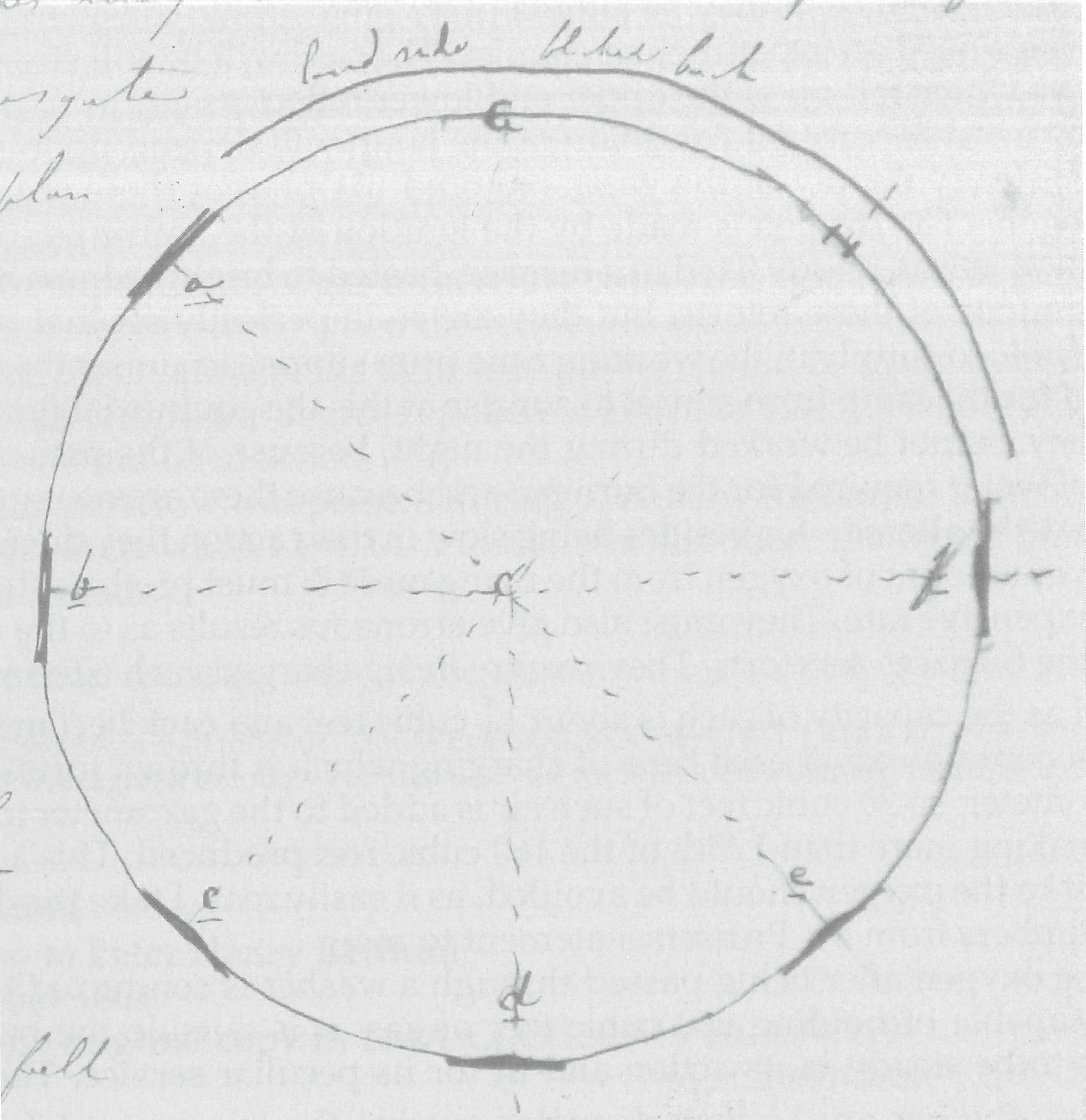 the jets A & H were not in action then the sea or land off a would not be lighted by three flames but by two only a
& b. Off b. three burners would be visible a b. & c. Again off e three burners would be visible d e & f & in any
intermediate place either three or four light[s] would project their rays
giving full illumination. Off f however only 2 would be
visible so that the full illumination would not extend very far beyond the
angle b c e, or 135°. Outside of
160° or 180° it might be expected to be sensibly diminished.
On the other hand it is just possible that the capability of crowding the jets together towards a given part of the horizon might sometimes present an advantage.
The adjustment of the optical apparatus for this lamp and the so called foci which are afterwards to regulate the place of the lamp to the apparatus will differ from those of either the ordinary oil lamp or the electric spark. The focus for the central part of the apparatus will not be either the nearest or the furthest distance of the three or four visible lights at their nearest or farthest distance from a given point of the glass opposite to them but at some intermediate distance. It may be judged of by philosophic consideration but will perhaps need an experimental enquiry. The case will be still stronger for those rays which fall upon the upper and lower reflectors[.]
The good & constant condition of the lamp will depend upon the sufficient & steady supply of the gases required. At present these are oxygen & hydrogen - The oxygen is made by the ignition of the native per oxide of manganese in iron retorts fixed in a furnace, heated to bright redness by coke. There are four of these retorts; but they are so imperfectly set that they are scarcely able to supply in the working time from sunrise to sunset the oxygen required for the lamp from sunset to sunrise at this the equinoxial time of the year. They cannot be worked during the night, because of the pressure of 6 inches of water required for the burners, and because there are no regulators. They are to be altered:- for besides being slow in their action they do not yield the proper amount of oxygen from the manganese & must produce the gas at a very expensive rate. They must also give erroneous results as to the wear & tear of the furnaces & retorts. They require being charged each 6 times in the day and as the capacity of each is about 1¼ cubic feet and each becomes filled with hot common air at each time of charging which is thrown forward into the gazometer; so 30 cubic feet of such air is added to the gazometer in the 12 hours making more than 1/5th of the 160 cubic feet produced. This addition of the air to the oxygen should be avoided, as it easily may. I take the data for these numbers from Mr Prossers statement to me[.]
The oxygen after being passed through a washer is conducted to a gas holder capable of holding 600 cubic feet of gas: it is outside the building, appears to be steady in its action and fit for its peculiar service. The pipes conveying the gas are 1 ½ inch diameter outside the tower - and 1 inch in the tower: no inconvenience has as yet been experienced at Westminster Bridge or elsewhere from the action of cold on such exposed pipes. There are cocks at the gas holder & also in the lanthorn governing the progress of the gas; the pressure upon it when the lamp is burning is 6 inches of water.
The Hydrogen gas is at present made by heating to redness a mixture of equal weights of Iron barings & crushed coke dust in iron tubes placed in a special furnace; and then passing over it a stream of steam. There are three tubes which require only once charging for the day; & they, with the furnace, seem to do their duty very well. The gas is passed through a washer as in the former case and then on to a gazometer of the same size and arrangement as that for the oxygen. A sufficient supply for the nights consumption is produced in three hours[.]
There is an apparatus for the generation of hydrogen by the action of diluted sulphuric acid on Iron or zinc[.] It consists of three large earthen ware bottles - it has been used, & may be used again, if occasion require it.
Two men were at work in the gas department[.]
The whole quantity of gas burnt in the 12 hours upon the six jets is about 560 cubic feet which is nearly at the rate of 7.7 cubic feet per jet per hour. The proportion of the two gasses is about 248 oxygen to 312 hydrogen or 1 to 1.26[.] If the gasses were pure it should be as 1 to 2. the introduction of the common air at the chargings will account for much of this: impurity in the manganese for much more[.]
The expenditure of gas & therefore cost of the light has to be determined which can only be done when the retorts &c are in perfect working order[.]
The observation of the light as to power should be made from the sea & at bearings within the degrees spoken of above or else the whole of the eight burners should be in action[.]
Captn. Arrow was present during part of my time at the light house and remained there when I left. Mr Prosser was also there the whole time2[.]
M. Faraday
Please cite as “Faraday4070,” in Ɛpsilon: The Michael Faraday Collection accessed on