From W. T. Thiselton Dyer 23 July 1875
10 Gloucester Road | Kew
July 23. 75
Dear Mr Darwin
I send you my notes on the variation of animals and Plants.1 You will see that they are a very minute contribution
I have copied out for you what seems to me an interesting case of bud variation in the Sugar cane
Another case of which we have photographs and sketches in the Kew Museum is that of an Orange Pearmain apple which produced a fruit of the russet type. see Gard. Chron. 1873, 1536 It came from Mr G. Lee Clev⟨e⟩don Bristol.2
Dr Hogg3 could give you ⟨man⟩y other instances but you no doubt have enough.
I see that it was ⟨6 or 7 lines and part of diagram excised⟩
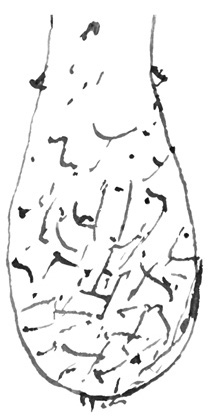
there was no great difficulty about it It was raised from seed obtained ⟨ ⟩ Major Trevor Clarke.4 The odd theory is that “the upper ⟨6 or 7 lines excised ⟩
On second thoughts I am inclined to think that Fritz Muller’s Cattleya ⟨ ⟩ ⟨ ⟩ed by Epidendrum5
[Enclosure 1]
Potato vol. i. p. 330
There is an account of the wild Potato by Sabine (with a plate) Trans. Hort. Soc. vol. 5 pp. 247–2596
p. 331 The following may be interesting
“On peut accelerer la précocité en prenant des fruits provenant des fleurs les plus précoces. C’est peu le moyen que Knight a obtenu les pommes de terre si hatives de l’Angleterre. Une fois cette précocité fixée, at après tout ce n’est pour la plante qu’un état de nubilité plus prompt, elle se perpétue par les plantations de tubercules.
Morren, Instructions populairs sur les Pommes de Terre Sepr. 21, 1845 p. 297
p. 379 Dr. Marsters8 told me that Cedo nulli a small yellow chrysanthemum habitually produces branches with white flowers
I saw a case at R. Hort. Soc. Nov. 11. 749
p. 397 117/ for Swayne read Goss
“the colour of the skin is modified when pollen ⟨of⟩ a differently coloured variety is used” This of course would be an alteration in the tissues of the female parent. The seed-coat in Leguminosae represents the ovular coats + the residue of the nucleus
In Goss’s experiments Mr Knight considers that the cotyledons only were changed and were perceptible as blue through the semitransparent seed-coats which remained white see Trans. Hort. Soc. vol 5 p. 37910
p. 399. 122/ Trans. Hort. Soc. vol. iv read vol iii11
p. 400 note 124 line 1 for see ‘Proc. read see ‘Journ.’12
p. 401 note 130 line 3 for ‘Proc. Hort. Soc.’ read ‘Journ. Hort. Soc.’13
note 131 see also 1749 but I have no note of the page14
note 132 line 2 for 63 read 6515
note 138 see also Agricultural Gazette. 1873 p. 171416
⟨several lines excised⟩
p. 343 Dr Boswell Syme17 told me that it is the Early varieties that fruit. See also accompanying letter from Mr Barron and foregoing remarks sub. vol. 1 p. 331 from Morren18
[Enclosure 2]
Royal Horticultural Society, | Chiswick Garden, W
July 19th 1875
Dear Sir,
It is a fact so far th⟨at⟩ “the varieties of the ⟨potato⟩ which produce tubers very early in the season rarely bear flowers”19—but I do not think that any conclusion can be drawn from it—as the early varieties are mostly of one type—variations of the Ashleaf Kidney— There are early round Potatoes not so well known—that flower profusely—and a second early section—the Lapstone—flowers the most abundantly of all but never bears berries.
There are some late varieties that seldom flower, such as the Scotch Blue. were we to have as many varieties of this and to cultivate them as extensively as the Ashleaf—the rule would be applicable at the other end.
I am Dr. Sir | your obt. Ser | A. F. Barron
Prof. Dyer—
CD annotations
Please cite as “DCP-LETT-10089,” in Ɛpsilon: The Charles Darwin Collection accessed on