From Daniel Mackintosh 15 January 1880
36 Whitford Road | Tranmere, | Birkenhead,
15th Jan. 1880
Dear Sir,
I send a syllabus of a paper I am about forwarding to the Geological Society.1 I can easily understand how the retreat of the sea may have left the terraces of Patagonia,2 while in this neighbourhood the sinking of the land was the cause of the submergence. But I have not made any positive assertions on the subject.
I find from your paper in the Phil. Magazine that you were the first to notice the proofs of the violent stranding of floating ice, which I cannot but regard as the most remarkable of all the Moel Tryfan phenomena.3 I have made use of the term “violent impact” &c in my paper.
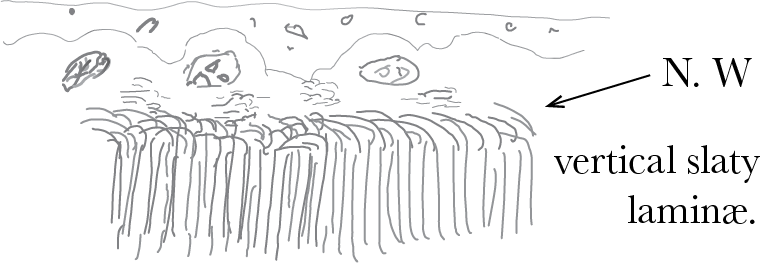
Clay above all—parcels of clay rolled up in sand,—& parcels of slate chips rolled up in sand.
With many thanks for the letters with which you have honoured me,4 | I am, Dear Sir, | Yours very truly, | D Mackintosh
Please cite as “DCP-LETT-12426,” in Ɛpsilon: The Charles Darwin Collection accessed on