From Archibald Geikie 29 December 1871
Edinburgh,
29th. Decr. 1871
My dear Sir
I am greatly interested in the enquiry you describe in your letter of yesterday.1 Only a few days ago I had occasion, in lecturing to my students, to give an account of your early observations on the action of the common earth-worm in the formation of mould, and to refer to the constant removal of the surface soil by rain and its renewal by worms.2 And I am therefore peculiarly delighted that you have taken up the subject again and that we may look for some explicit data from you as to the modus operandi and the rate of action of the different agents.
I have observed the ancient grass covered terraces and ridges in many parts of Scotland, sometimes running up & down, sometimes along the slopes. In some cases, for example near Romanno Bridge in Peebleshire and on the East side of Arthur’s Seat, Edinburgh, those terraced lines have even been absurdly confounded with raised-beaches & old sea-margins.3 I merely mention this to shew you the horizontality & conspicuousness of the features—
In the case of old British forts of which there are thousands in the pastoral unploughed uplands of the South of Scotland, I have usually found the section of the ramparts to be as shewn below;—the filling up of the trenches & lowering of the ramparts varying constantly with the materials and with the height & wetness of the site—
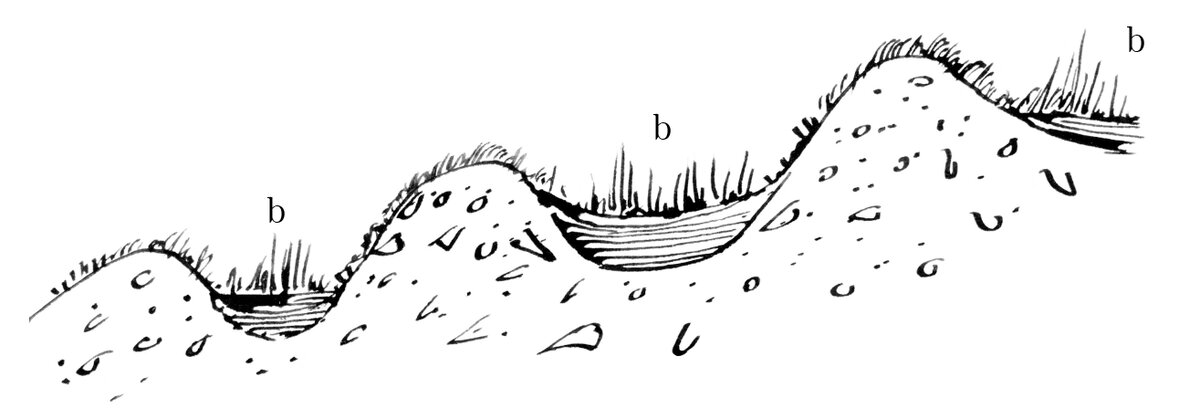
a. made-earth & stones
b. Fine loam filling bottom of trenches
The Trenches are often flat-bottomed and marshy especially where the Fort is made on a clay site and they frequently support a growth of rushes while only a short sweet green turf coats the sides of the ramparts.
When a fort is placed on a slope I have noticed a tendency in the lower part of it to fade as it were sooner than the upper part, whether by the filling up of the trenches or greater denudation of the ramparts or both.
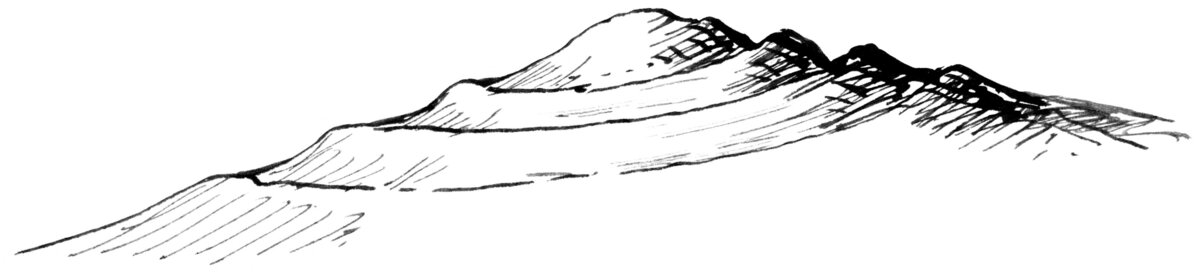
Of course there are many exceptions to this statement and I could hardly perhaps lay it down as a general rule.
With regard to the ridges of ancient ploughed land, so far as I have noticed, they more frequently run up & down hill than transversely. At the same time the most marked features attributable to old cultivation (such as is still practised in the so-called “lazy-beds” of the Highlander & Irish) run so far as my own experience goes along the slope as in the cases of Romanno Bridge & Arthurs Seat already referred to.
I have not examined any of the examples for some years, not since my attention has specially turned to the subject of subaerial denudation. There may be therefore many points to notice which one would now study eagerly. I shall take an early opportunity of looking at the Arthurs Seat lines & if any point of interest should appear in them I shall be glad to send it to you.
With regard to E de Beaumont’s idea of the layer of vegetable soil being a zero-point, you will be interested to contrast with it the earlier & far more philosophical view of Playfair (Illustrations p 106.) who says that the permanence of the layer of vegetable soil furnishes “a demonstrative proof of the continual destruction of the rocks”.4 I have quoted the passage in the new Edition of Jukes Manual of Geology as a contrast to the notions of the French School.5
Believe me to remain | Yours very truly | Arch Geikie
Charles Darwin Esq | FRS. &c &c.
CD annotations
Please cite as “DCP-LETT-8123,” in Ɛpsilon: The Charles Darwin Collection accessed on